> ## Documentation Index
> Fetch the complete documentation index at: https://docs.vobiz.ai/llms.txt
> Use this file to discover all available pages before exploring further.
# Origination URI - SIP Destinations for Inbound Calls
> Manage SIP Origination URIs in the Vobiz Console - the destination addresses (host:port + transport) Vobiz forwards inbound PSTN calls to. Walkthrough of the URI list, details, and Create Origination URI form.
An **Origination URI** is a SIP destination address - `host:port` plus transport - that Vobiz forwards inbound PSTN calls to. Each [inbound trunk](/platform/sip/inbound-trunks) picks one URI as its Primary, and you can keep multiple URIs on hand for primary/backup routing or per‑region delivery.
```text URL theme={null}
https://console.vobiz.ai/app/sip/in/uri
```
## The Origination URI list
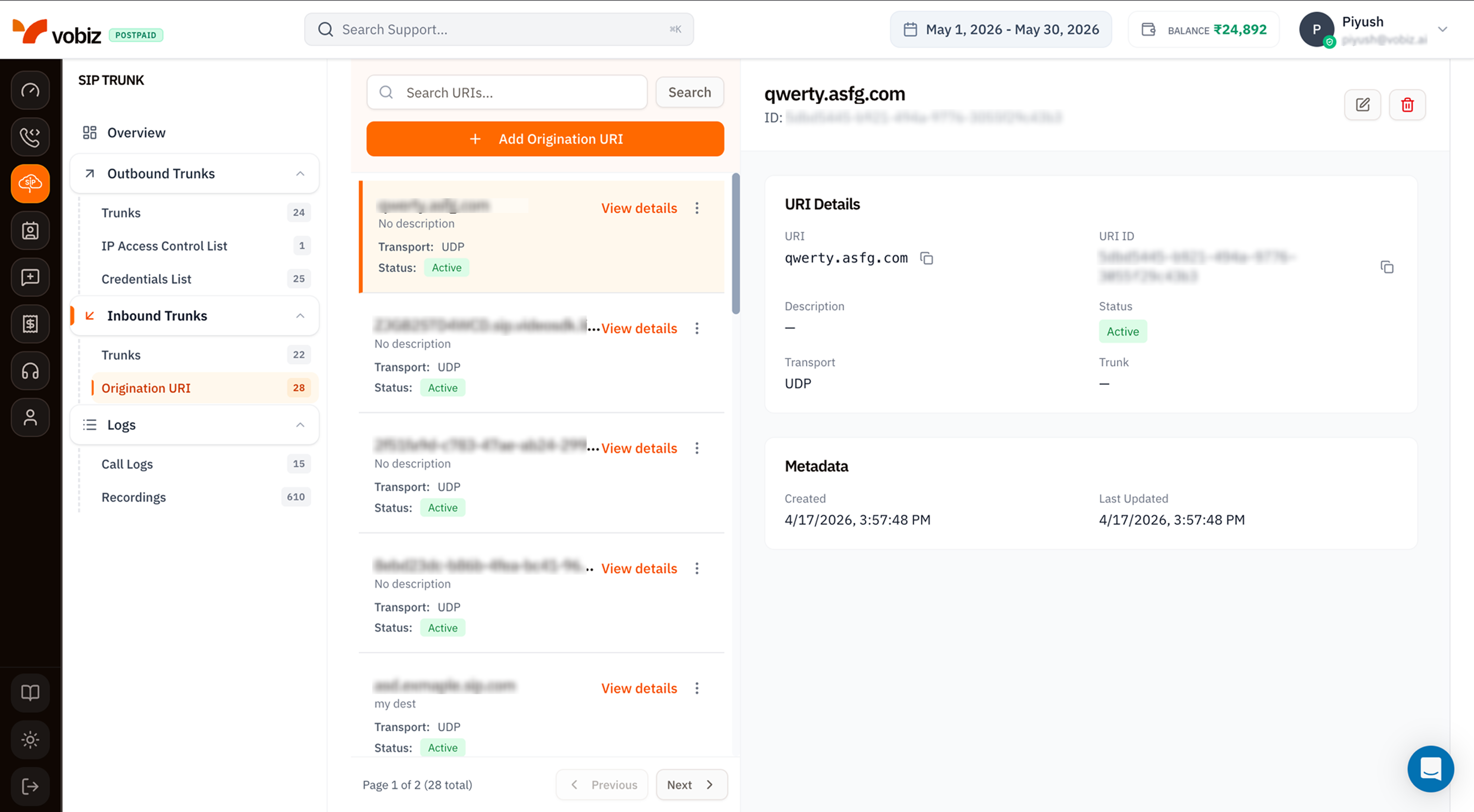 | Column | Meaning |
| ------------- | -------------------------------------------------------------------------- |
| **URI** | The SIP host (and optional port). Vobiz POSTs the INVITE here. |
| **Transport** | `UDP` (default), `TCP`, or `TLS`. Picked when you create the URI. |
| **Status** | `Active` accepts calls; `Inactive` rejects (carrier sees a routing error). |
Click any card to load its details on the right.
## Details panel
| Section | Field | Meaning |
| --------------- | ---------------------- | ----------------------------------------------------------- |
| **URI Details** | URI | The host (and port). |
| | URI ID | Immutable UUID. |
| | Description | Optional notes. |
| | Status | `Active` / `Inactive`. |
| | Transport | `UDP`, `TCP`, or `TLS`. |
| | Trunk | The inbound trunk this URI is currently linked to (or `—`). |
| **Metadata** | Created / Last Updated | Both in your browser timezone. |
## Create an Origination URI
Click **+ Add Origination URI** to open the side panel.
| Column | Meaning |
| ------------- | -------------------------------------------------------------------------- |
| **URI** | The SIP host (and optional port). Vobiz POSTs the INVITE here. |
| **Transport** | `UDP` (default), `TCP`, or `TLS`. Picked when you create the URI. |
| **Status** | `Active` accepts calls; `Inactive` rejects (carrier sees a routing error). |
Click any card to load its details on the right.
## Details panel
| Section | Field | Meaning |
| --------------- | ---------------------- | ----------------------------------------------------------- |
| **URI Details** | URI | The host (and port). |
| | URI ID | Immutable UUID. |
| | Description | Optional notes. |
| | Status | `Active` / `Inactive`. |
| | Transport | `UDP`, `TCP`, or `TLS`. |
| | Trunk | The inbound trunk this URI is currently linked to (or `—`). |
| **Metadata** | Created / Last Updated | Both in your browser timezone. |
## Create an Origination URI
Click **+ Add Origination URI** to open the side panel.
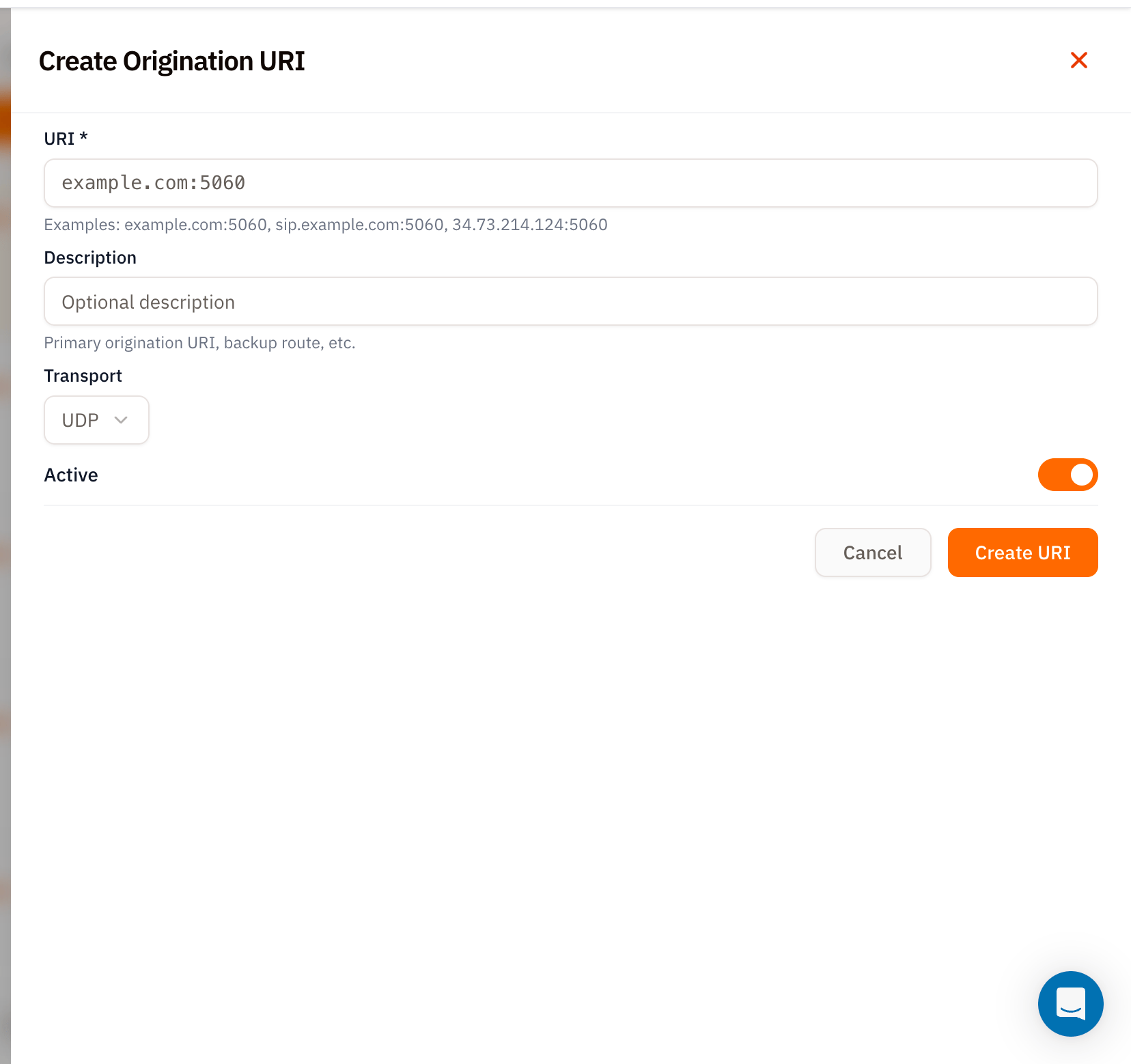 | Field | Required | Notes |
| --------------- | -------- | --------------------------------------------------------------------------------------------------------------------------------- |
| **URI** | ✅ | `host:port` form. Examples: `example.com:5060`, `sip.example.com:5060`, `34.73.214.124:5060`. Port defaults to `5060` if omitted. |
| **Description** | – | Free‑text label like *"Primary Mumbai PBX"* or *"Failover route"*. |
| **Transport** | – | `UDP` (default), `TCP`, or `TLS`. Pick `TLS` if your PBX expects encrypted SIP. |
| **Active** | – | Defaults on. Toggle off to provision without routing traffic. |
Click **Create URI**.
## Link the URI to an inbound trunk
Once the URI exists:
1. Open an [Inbound Trunk](/platform/sip/inbound-trunks).
2. Edit the trunk and pick this URI from the **Primary URI** dropdown.
3. Save.
Vobiz immediately starts forwarding inbound calls on the trunk's linked numbers to this URI.
## Multiple URIs - primary / backup
A URI created here can be reused across many trunks, or you can keep several URIs on standby for fast failover:
1. **Primary URI** stays linked to the production inbound trunk.
2. **Backup URI** stays `Active` but unlinked.
3. When the primary PBX goes down, switch the trunk's Primary URI to the backup - propagation is instant.
For automatic failover at the carrier level, contact [support@vobiz.ai](mailto:support@vobiz.ai) - multi‑URI fallback is a per‑account configuration.
## Tips
* **Always include the port.** `example.com:5060` is clearer than relying on a default - and several common firewalls reject SIP without an explicit port.
* **Use TLS for cloud PBXes.** UDP over the open internet is fine for fixed‑IP deployments, but TLS prevents eavesdropping and SIP fingerprinting for cloud setups.
* **Name the URI well.** The list grows fast; "Primary Mumbai PBX" beats `34.73.214.124:5060` when you're staring at 28 entries.
## What's next
Link this URI to a trunk and start receiving calls.
Verify inbound traffic landed on the right URI.
| Field | Required | Notes |
| --------------- | -------- | --------------------------------------------------------------------------------------------------------------------------------- |
| **URI** | ✅ | `host:port` form. Examples: `example.com:5060`, `sip.example.com:5060`, `34.73.214.124:5060`. Port defaults to `5060` if omitted. |
| **Description** | – | Free‑text label like *"Primary Mumbai PBX"* or *"Failover route"*. |
| **Transport** | – | `UDP` (default), `TCP`, or `TLS`. Pick `TLS` if your PBX expects encrypted SIP. |
| **Active** | – | Defaults on. Toggle off to provision without routing traffic. |
Click **Create URI**.
## Link the URI to an inbound trunk
Once the URI exists:
1. Open an [Inbound Trunk](/platform/sip/inbound-trunks).
2. Edit the trunk and pick this URI from the **Primary URI** dropdown.
3. Save.
Vobiz immediately starts forwarding inbound calls on the trunk's linked numbers to this URI.
## Multiple URIs - primary / backup
A URI created here can be reused across many trunks, or you can keep several URIs on standby for fast failover:
1. **Primary URI** stays linked to the production inbound trunk.
2. **Backup URI** stays `Active` but unlinked.
3. When the primary PBX goes down, switch the trunk's Primary URI to the backup - propagation is instant.
For automatic failover at the carrier level, contact [support@vobiz.ai](mailto:support@vobiz.ai) - multi‑URI fallback is a per‑account configuration.
## Tips
* **Always include the port.** `example.com:5060` is clearer than relying on a default - and several common firewalls reject SIP without an explicit port.
* **Use TLS for cloud PBXes.** UDP over the open internet is fine for fixed‑IP deployments, but TLS prevents eavesdropping and SIP fingerprinting for cloud setups.
* **Name the URI well.** The list grows fast; "Primary Mumbai PBX" beats `34.73.214.124:5060` when you're staring at 28 entries.
## What's next
Link this URI to a trunk and start receiving calls.
Verify inbound traffic landed on the right URI.